Between garden and forest
Prelude
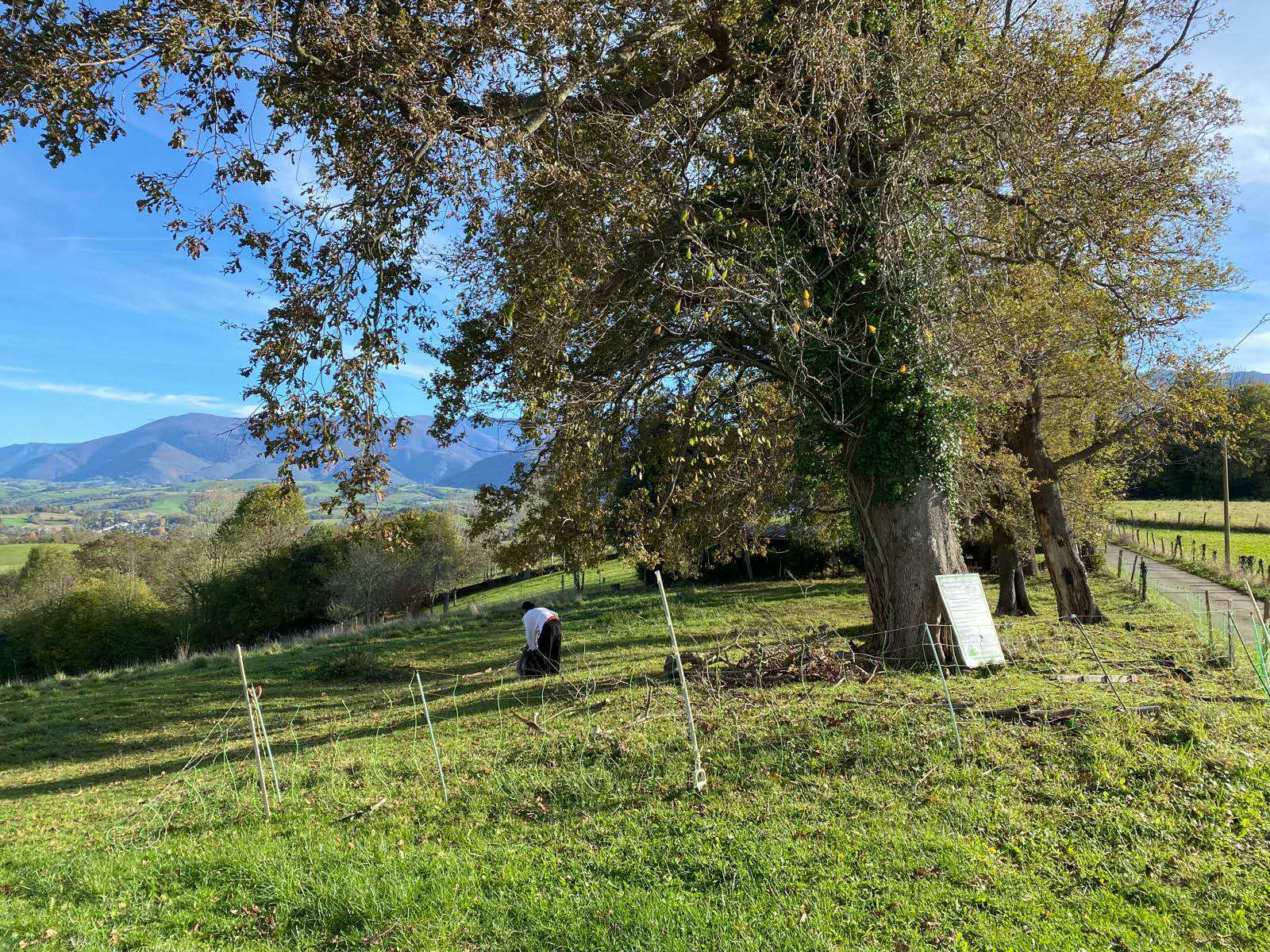
Our terrain is quite interesting. Miramon is perched on a small hill. Cycling here from the nearest village requires strong leg muscles, as the path winds up the mountain with almost no flat sections. Because of our elevated position, standing beneath the oak trees, you can gaze far into the distant mountains to the west. To the east lies an exceptionally open vista, the horizon stretching flat. The magnificent sunrise is a gift from the sun to this land. This elevation also means one-third of our land is steeply sloped, where our fruit trees will be placed. While the flatter areas are reserved for vegetable gardens and buildings, this steep section provides excellent wind protection. Imagine the wind sweeping in from the west, cooling as it passes over snow-capped peaks, then racing across the open fields. By the time it reaches our hilltop, it’s a powerful force—strong enough to topple trees that are too thin or rigid. So while the steep, east-facing slope gets less sunlight, it at least escapes the relentless battering of the wind. However, a problem arises: for those of us who tend to these trees and gather their fruit, the slope presents challenges. I believe a suitable path is necessary.
As a graphic designer, I can’t help but sketch out the designs in my head. Every time inspiration strikes, I can’t resist sharing it with Dorian, but almost every time I get a negative response: “Oh, maybe we could plant these trees, let’s see,” or "Oh, the path would require a lot of earthwork, right?“ In short, the problems always outweighed the solutions, leaving me feeling quite discouraged. Upon dissecting our problem, we find that Dorian felt I hadn’t included him as part of the design team. Also, because my sketches were often times overly detailed, they seemed to leave no room for negotiation. So he would use his “veto” to bring the rhythm back to collaboration. And we gradually understood that creating this lively garden is not as simple as planting several fruit trees and requires more than two weekly meetings.
In the end, rather than rushing into things, I decided to spend more time truly learning how to design a food forest, in order to propose the tools of design for a collective creation. I primarily studied two books on the subject: one is Vivre avec la Terre by Perrine and Charles Hervé-Gruyer, creators of the Ferme du Bec-Hellouin, well-known in Francophone permaculture circles. Within this three-volume masterpiece, there’s a chapter dedicated to designing a high-yield food forest, aimed at arborists seeking to make a living from fruit trees. The other is Fabrice Desjours’ Jardin-forêts, which focuses primarily on the “forest” aspect—how to create an ecosystem requiring almost no management. Additionally, I attended a two-day training course on designing edible hedgerows. The design philosophy behind this is called syntropy.

At first, all those practices and dos and don’ts created a mess in my head. I tried to compare them in the hope of finding one practice that takes the advantages of the three. It was a complicated juggle. A few days later, an epiphany hit me: of course, there are rules about how to make a good design, but there will never be a set of formulas that work for every garden. We need to first look into the natural evolution of the land, so we can then gain insights into why those rules exist and gain also much wiggle room in the operation. Once you understand the central design, which is nature’s way, everything inevitably evolves around it, and you get to better position your activities.
The nature’s way
Thinking in time
Let us ponder on this notion: a free, open grassland, in a warm climate, when left to its own, will not stay a grassland forever.
Plant succession is both the skin of the earth and the vitality of the world, allowing nature to enrich environments and constantly move from stripped simplicity to renewed complexity.
Plant succession begins with the germination of annual ruderal plants, which colonise disturbed, bare soil. These early arrivals quickly fill the void and protect the earth from erosion and UV rays. When they die in the first winter, they become a source of thin, newly formed litter. These essential plants include amaranth, shepherd's purse, bird's knot-weed, and white goose-foot. If nothing interrupts this new cycle, over the months, the procession of annuals will be joined by perennial herbaceous plants. Then pioneer trees (alders, willows, birches, etc.), bushes, and brambles will arrive, eventually giving way, over the years, to the trees of a mature forest (hornbeam, beech, etc. in Europe). (Jardins-forêts, p.91)

Image Source
Let’s take the example of the thorny bramble, hated by most farmers, a common symbol of neglect of the land. Actually, brambles give food to the birds, then the birds will come and help spread the seeds of other plants through their excrements, and the bramble will then grant protection/shade to the young seedlings. Once the trees grow above them, the brambles, not liking being in the shade at all, will die and give space to other vegetation. A small forest will come to be, with the fallen leaves and animal nutrients, and of course all the earth dwellers, eating and digging away, working the soil without intentionally working it, the forest becomes richer and richer - self-fertilising is the agricultural term used to describe its ability to stand on its own.
Now we can compare our activities with the natural succession of vegetation which is a forest’s becoming. Planting vegetables is essentially cultivating annuals, working the land so that it stays in its first state of progress. Working against the natural process demands thus a lot of work: grass removal, importing nutrients, controlling pests... Each activity represents a fair amount of time for an organic vegetable gardener. Likewise with orchards: Even in organic ones, it’s very common to find it necessary to apply treatments to fruit trees. I believe that apple trees are the heaviest users of pesticides. Why? Because we have isolated one type of fruit tree and forced them to grow densely together, which will never exist in a natural environment. Lacking diversity, thus lacking the host environment for auxiliaries, the fruit trees are fragile in the face of parasites.
Understanding a food forest
Now, if we try to plant a food forest, since we have the same end goal as the land, we are off to a less difficult start. In a natural process, the formation of the forest might take several decades, and we cannot select the ideal strains. So all of the know-hows of designing a food forest is essentially mimicking the natural process, but accelerating it. Planting the trees we want is doing the work of the birds, bringing seeds. Protecting the young trees with fences and covering them with mulch is doing the work of the thorny bramble, giving them protection.
Different strata in (vertical) space and time
Then there is the question of shade. I used to think from the perspective of cultivated tomatoes, which is to say that I imagined that all vegetation needs plenty of light, the more the better, the hotter the better. It turns out even tomatoes will shut down their photosynthesis when the light is too strong, which is why they particularly enjoy being in a greenhouse, with diffuse light, maximum temperature and moderate humidity. But stepping out of the skin of tomatos, I realised that all vegetation needs some kind of shade. Some strains are more hungry for light; the botanists call them heliophiles: poplar, eucalyptus, etc. In a food forest, they can form the highest strata, giving protection to the lower strata. In the book of Bertrand Desjours, he calls them AFI (architectural, fertilisant, et ingénieur); in the syntropic vocabulary, they are called the emerging layer (strate emergente).
Observing the indigenous people’s way of living with the forest, Robert Hart summarised 7 different layers:
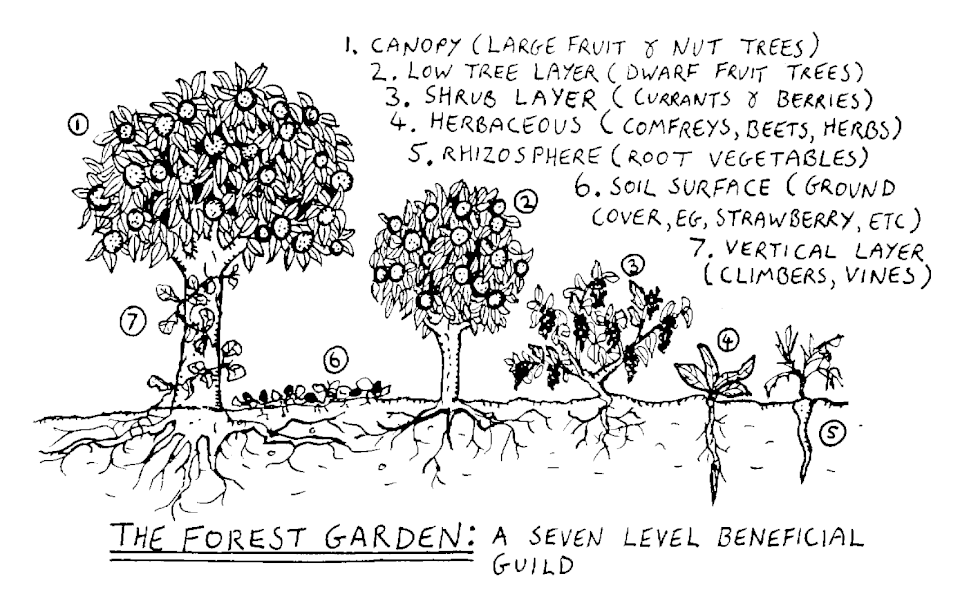
Diagram by Graham Burnett
- A canopy layer that consists of tall fruit and nut trees.
- A lower tree layer of dwarf fruit and nut trees.
- A shrub layer of fruit bushes such as currants and berries.
- A herbaceous layer of culinary and medicinal herbs, companion plants, bee- and poultry- loving plants.
- A ground cover of edible plants that function as a living mulch.
- A rhizosphere layer that consists of root crops.
- A vertical layer of vines and climbers.
Nature, with her low-key genius, knows how to share the light; every species grows in harmony with another species. One might think that the tallest tree will be predominant and close the canopy, but don’t forget that their roots communicate; more and more studies show that trees communicate through their roots with the help of mycorrhizae. They mutualise resources such as water and carbon, even sending signals of danger.
Disturbance and fertilisation
A more complex aspect of designing a food forest is how to achieve self-fertilisation. Again, in order to accelerate this process, we might bring nutrients from outside: manure, straw. But to stimulate self-fertilisation, it’s preferable to plant densely, as more vegetation equals more OM (organic matter) for the soil (and less grass to manage). How to bring the OM faster to the ground? One option is to grind pioneer species (AFI), reintroduce wood chips into the soil, or pruning trees heavily. Another important method of adding nutrients is to plant vegetation that has the inherent ability to fix nutrients, such as nitrogen.
One question should be raised: Is it really a good idea to disturb the trees? One striking practice might be that of pollarding trees. During the syntropy course, the coach told us that our neighbors, the Basques, have a long history of pollarding trees. It’s an ancient farming know-how which consists of ‘beheading’ a young tree and cutting off all extra branches. It will look very much like a wooden stick at this point, and the sight of it may give a nature lover much heartache and horror. But again, nature, mysterious as she is, hides the trees’ rich root system from our eyes. Once the spring arrives, their sap rises to the top, and finding no pre-existing branches to feed, pushes the bud in hibernation into full expression. Without the top branch secreting its growth inhibitor, the wooden stick blasts into an umbrella of dense foliage. Then the following spring, one can continue the same process, rendering the tree thicker and thicker. That’s how people, for centuries, provisioned themselves with heating wood. Instead of cutting down a full-grown tree and having wood to burn for several winters, they harvested their wood every year like fruit. Apparently, pollared trees lives longer than their contemporaries. The record is held by a 1,300-year-old oak tree located in Windsor Park, England, even though this species does not usually live longer than 800 years. Once again, in order to accelerate the forest-forming process, we do the work of a hungry deer or a night thunder, disturbing the vegetation in a reasonable way so that it regenerates itself with more vigor.
So now we have the basic building blocks of a food forest: diverse (in species and in space), and dense (especially the heavy trimming part). Please find more design details on [this article] where I documented the syntropy course.