What foundations for Miramon?
The question of the type of foundations to choose for our house is undoubtedly one of the thorniest issues we face. In fact, it's at the intersection of several essential issues that arise for our project... And given that the whole house is going to be quite literally based on this, it's not a question to be neglected from a philosophical point of view either!
So, what are we wracking our brains about?
1. The ecological impact of concrete
First and foremost, one of the key objectives we've set ourselves with this project is to adopt as eco-responsible an approach as possible. This is a fundamental point: the absurd system in which we live makes it seem very complicated (if not impossible) for us to live in a light or reversible habitat, due to the hostile attitude of the powers that be (the préfecture of the Pyrénées-Atlantiques département, where we wish to settle); we have neither the means to invest in a habitable building, nor to buy a ruin to restore it (otherwise we'd be the ones ruining ourselves, and for good); consequently, to establish ourselves near Mifaget, where the collective project we're launching with our friend Renée is based, we have no choice but to build a new house. And any new build, if you want to comply with thermal regulations (or just have a house that's more or less comfortable in winter and summer), has a major ecological impact, if only in terms of the use of materials, energy consumption for transport and the use of site machinery, etc. (*).
However, 'standard' foundations, as presented in just about every book and website on house building, are made of concrete. In the category of so-called 'superficial' foundations, i.e. those no more than 3 m deep, people mostly talk about 'threaded footings', which run the full length of the load-bearing walls, and 'insulated footings', which are concrete blocks placed under the load-bearing walls at strategic points. And concrete (made from Portland cement), as we know, is extremely polluting...
For example, in terms of its impact on climate change (there are others: energy use, water consumption... not to mention occasional profit-driven support for genocidal terrorist groups): cement manufacturing is estimated to account for 7% of all greenhouse gas emissions worldwide; and the building sector, its main consumer, generates 23% of France's emissions (source). For one cubic metre of conventional concrete without reinforcement, weighing 2,310 kg, the carbon footprint is 197 kg eq CO2, or 85 kg eq CO2 per tonne of concrete (source). By way of comparison, once our house is built, if we burn 3 steres of wood per winter to heat it (it will probably be less!), and it's dry oak, we will produce around 6,600 kWh (6.6 MWh) of energy according to this calculator. And according to this report, the production of one MWh of thermal energy by the wood energy sector in France would represent in the worst-case scenario 30kg eq CO2. So 6.6 MWh = 198 kg eq CO2 = one cubic metre of concrete! At a rate of 3 steres per year, each year we would consume in the worst case as much energy to heat our homes as it takes to pour a cubic metre of concrete foundations... (but given that we'll be buying our wood locally, and using very little of it - see the asterisk (*) - the ratio will be much lower). This would be a huge contradiction with the spirit of our project.
2. Our budget
An interesting alternative to concrete, and one that is gaining increasing recognition, is that of screw piles. These are fairly large steel screws that are driven deep into the ground, using a machine, until a stable layer is found. All that's left to do is put the house on top!
The advantage of this method is that it doesn't alter the landscape (no earthworks are needed), is suitable for sloping ground (such as ours at Miramon)... and doesn't require the use of concrete. It's suitable for fairly light buildings like the one we're going to build.
Unfortunately, there is the question of cost. Our budget for this project fits into a mini pocket handkerchief. And unfortunately, the estimates we requested for the use of this technique (from the main French player in this field, TechnoPieux) immediately put us off: given the clayey nature of the soil, the screw piles would have to be driven to a depth of at least 7 metres (if not more), which, in addition to the preliminary study, would represent an expense upwards of 12k euros.
This cost issue also applies to the use of concrete foundations, however!
3. Seismic standards and terrain characteristics
On top of that, we have to deal with the characteristics of the terrain.
Geographical constraints: seismicity
The commune of Lys is located in seismicity zone 4 (medium), due to the nearby presence of the young Pyrenees mountain range, which continues to grow like a geological teen. This is a scale that goes up to 5 (the only French departments in zone 5 are the volcanic islands of Martinique and Guadeloupe).
Admittedly, whether in ancient or more recent times, it would appear that our region has not been the site of particularly intense seismic activity: the only notable occurrences are a magnitude 5.3 earthquake did occur in Arette in 1967, another in 1750 near Lourdes, and a third in 1660 just next door in Bigorre. But you never know...
In any case, if we wanted to comply with the official seismic standards for single-family homes located in our seismic zone, and therefore be a little safer from an untimely earthquake, we'd have to take some major measures in terms of foundations. And as luck would have it, these measures involve... a lot of concrete! Preferably reinforced.
But what happens if you build without complying with these standards? As someone at the local authority told me, in a particularly sinister tone of voice, 'there could be legal consequences' - the implication being, if our house collapsed one day because of an earthquake, and someone was underneath, and we were sued for it.
Beyond the concern - which we may not have, as self-builders – of staying within the boundaries of the law, there's also the question of whether reinforced concrete is really necessary to protect against earthquakes... Given that it is a technology that is less than a century old, and that millions of buildings have been constructed in the past around the world, in seismic zones, using vernacular foundation techniques, without ever collapsing! Perhaps some of these techniques are proving effective enough to be adopted (more on this below).
Geotechnical constraints: clay
The second constraint we have to deal with on our future site is the problem of clay shrinkage and swelling. In soil that is strongly affected by alternating shrinkage and swelling, inappropriate foundations could also endanger the building. Given that the risk is tending to increase just about everywhere as a result of climate change, this is a point not to be overlooked... if you're on clay soil. Is this the case for us?
According to the G2 geotechnical study that we had to commission prior to our application for planning permission, under the grass of the Miramon meadow, the land is made up of two soil horizons:
- a layer of 'more or less gravelly clay loam with pebbles' to a depth of 3.5 to 5m;
- then a layer of clay to a depth of at least 6m (or even lower).
Furthermore, the G1 study carried out previously showed that according to a lab test establishing the proportion of silt and clay in a soil, our soil is type ‘A1’, which indicates a medium-low clay swelling potential. Basically, our soil is 'fine' (it has a high proportion of fine particles: silts and clays), but it's in a lower risk category because it's not extremely plastic.
In short, it's not terrifying on the face of it. The fact remains that the consultancy firm that produced these reports recommends the use of foundations with base depths of 1.20m (the 'drainage guard') in relation to the surface of the ground, as a precaution (which can be seen as rather conservative). And the solution mentioned in the G2 report for the foundations is unequivocal: 'shallow foundations of the threaded sole/isolated sole type (blocks/wells possibly connected at the top by stringers).' In short, the usual concrete solutions.
And yet, aren't there non-concrete foundations, other than the screw piles mentioned above, that have proved their worth - whether ancestral and vernacular, or reflecting a more contemporary 'low-tech' approach? I came across a few in the course of my research.
4. Alternatives to concrete
Tyres
Let's start with a 'materials reuse' foundation method: piles of used tyres (collected free of charge from garage owners), filled with rammed earth, gravel and/or a little cement. This is a solution used in many earthships, and is presented in all seriousness in several of the eco-construction books I've consulted (see [the bibliography]).
EDIT : Our friend Stefan Borret also reminds us of Tom Rijven’s Flexagone method:
Tyres filled with gravel are placed on the ground, which has been levelled below the vegetation line. The bottom rail is a Douglas fir U-profile, forming a hexagon that ‘floats’ on the tyre ‘piles’ (according to Tom, this unsecured floating can protect against seismic shocks). Tom Rijven is the pioneer of straw bale construction in France. Gurun Manrot, for example, the creator of the Paillourte, first learnt the trade on Tom’s building sites. Here is a lovely video of a Flexagone building site and its tyre foundations.
It's an attractive solution because of its low cost... but if we want to have both foundations around the 1.20m depth recommended by the design office, AND a crawl space of around 1m under the house slab (in particular to house a water recovery tank), we'll have to pile up tyres nearly 2m high... not exactly reassuring. Not to mention the potential pollution linked to tyres in the ground, a controversial subject.
Cyclopean foundations
Another type of foundation that is mentioned in a number of eco-construction works (see [our bibliography article]), particularly in English, is the rubble trench - or cyclopean - foundations. These are trenches filled with large stones that can be...
- rammed and compacted (by hand or machine) ;
- bound with 'Roman concrete' - i.e. a lime concrete, sometimes containing pumice stone and gravel, and/or pozzolan ;
- and/or crowned with a layer of concrete, forming a base for the rest of the structure.
This method was widely used in ancient times, particularly by the Romans. I heard about it on David Mercereau's excellent blog, where he used it for the foundations of his straw hut (see here, and there), for example. His blog posts include lots of links to explore this technique further (dare I say it), and a rich discussion in the comments. See also this tuto by Alliance4, this presentation by Chapeau et bottes, and this dossier by La Maison écologique.
Despite the fact that it has been used for thousands of years, in buildings and structures that have survived the ages, this method is not listed in any French reglementary text (DTU). As far as we're concerned, it's a method that could be considered as an alternative to concrete... but we'd still have to find a lot of large stones, and be prepared to pile them one after the other into our trenches. The online testimonials confirm that it's very physical, even gruelling! I'm not sure we'd want to go ahead without a pile of large, ready-to-use stones on our land... especially as, without having thousands of human slaves at our disposal like the Roman emperors, we'd have to use up a lot of 'energy slaves' in transport and machinery, which runs a bit counter to the spirit of our project.
Wooden piles and pilings
According to Yves Benoît (La maison à ossature bois par les schémas, p.118), 'the majority of structures built before the 19th century were founded on wooden piles'. Note the word 'structures': this type of foundation, made up of large piles of naturally durable species (such as black locust), to resist rotting, seems to have been used mainly in the construction of bridges and other infrastructure - in other words, in wetlands: rivers, marshes, coastal areas. We can also think of the buildings in Venice, built on wooden piles driven into the sand of the lagoon.
Would such piles be suitable for our project? There's very little information in French available online on the subject - with a few notable exceptions, such as the Projet Pieux Bois, a scientific project that led to the writing of a geotechnical thesis on the subject: Wooden pile foundation system: a thousand-year-old technique for tomorrow, by Jérôme Christin. One of the conclusions of this work is the relevance of returning to the timber pile technique in the face of the current ecological crisis. But while the thesis proposes some very advanced calculations for sizing piles, it remains rather difficult to access for non-engineers who just want to build a house...
But then, while researching the subject on the web, I came across an article that immediately caught my attention: Foundations on acacia piles: a complete guide and feedback on a straw house in Béarn by Valentine Médan. Not only is it a straw house very similar to the one we're going to build, and it was built in the Béarn region... but it's also a house built by people we know well: our friends Pierre and Véronique! We've even slept in it a few times. It's beautiful and comfortable. And I had no idea that it was built on wooden piles...
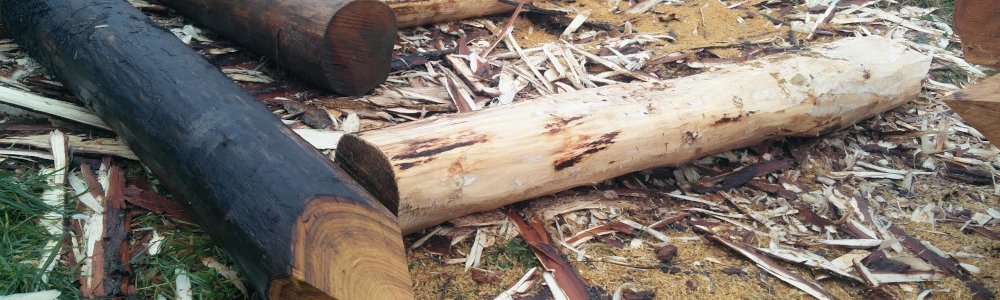
So I called Pierre to find out more. He explained that he had come across this solution in discussions with local farmers, whose acacia (Robinia pseudoacacia, or black locust) fences remain in excellent condition, decades after they were planted. He subsequently learnt that clay is particularly interesting for conserving wood - especially extremely solid wood such as black locust - because it protects the wood from excessive variations in humidity. His soil survey confirmed that the soil on his land was very load-bearing at a depth of around 1.50 m, and simple calculations (including the weight of the house, estimated at 90 tonnes, including additional loads from snow, wind, etc.) led him to conclude that 26 piles with a diameter of 30 cm would be enough to support the entire house. He dug pre-drilled holes with an auger, and a 22-tonne excavator then drove the piles in with its bucket. In just one morning, the job was done. Given that the timber came from a nearby sawmill, and was grown locally, his foundations cost him a pittance... Especially as he didn't do any earthworks. And ten years later, the foundations are fine - the thin layer of sapwood has been attacked, but not the heartwood - 'it's as if the wood was stored under the house'!
Of course, this method of construction doesn't comply at all with French paraseismic standards, and we have yet to confirm that it could work on our site. Pierre is working with two couples on straw-bale construction projects, also in the Béarn region, who will be using the same method for their homes from next month. We're definitely going to go for it. And what if it could work for us too?
To be continued.
(*) Even though in the long run, our aim is to build a house that is so well insulated and designed that it requires very little energy for heating, and none at all for air-conditioning; and we have the firm intention of living a rather frugal lifestyle, given the French or European 'norm' (we'll talk more about this in a future article on energy).