In search of an umbrella
Monday, 16 February. Up at 6:30 a.m., slept poorly. The stress of a big day of travelling, which I was a little apprehensive about. Our main mission today: to pick up an umbrella... measuring 120 square metres.
There are days like this that seem like imaginal cells, fractal images of the greater journey that is the construction of this house, itself a fractal reflection of the journey we make with our lives. Like concentrated, prismatic glimpses of what we are going through, what we are facing, what moves us. Today, this revealing journey will take the form of five memorable encounters.
1. Michel
The perfect weather for an umbrella search: it's raining. Nothing new under the leaden skies of the Périgord. The end of a short family stay, mainly on the occasion a screening of Mayuan's documentary. In the car on the way to our first appointment, the dull apprehension of having to drive 500 kilometres in a lorry in the pouring rain, crossing flooded areas. For the past few days, between the trees swept away by Storm Nils and the torrential rains, which have caused rivers and streams everywhere to burst their banks, getting around requires a certain amount of determination.
8:20 a.m. Michel arrives at the carpool area, we get in, and we're off. He kindly agreed to leave home half an hour early so we could catch a bus west of Brive.
The front of his SUV, with its streamlined windscreen, reminds me of an aeroplane cockpit. Two ultra-modern screens. Michel is in his sixties, with short white hair and a Franche-Comté accent. He is on his way to Besançon to move his son's flat. Rather gruff, but not unfriendly. Looking a little sad and disillusioned.
Shortly after we set off, something happens: the music on the radio gives way to a voice that sounds strangely familiar, and I soon recognise it. My suspicion is confirmed by the programme's jingle: 'You're listening to L'heure des Pros, with Pascal Praud, on Europe 1.' Pascal is on fire this morning. He exults, roars, and holds no punches: ‘The far left destroys, the far left kills! Anti-fascism is the true fascism of our time!’ I hadn't been following the news in recent days, so it feels like a rude awakening. A Monday morning that's off to a great start. I listen with a kind of astonished fascination, a clinical curiosity, to THE political news of the moment, commented on by one of the most hateful voices of the fascist wave that is sweeping the country.1 So this is what can be heard on the motorways of France this morning.
After a few minutes, Mayuan can't take it anymore and asks us to change the station to something less violent. Michel complies, but grumbles, ‘What's violent is that a young person was beaten to death for his ideas.’ I feel a flurry of responses rising in my head, each more incisive than the last. I refrain from entering into what promises to be a fruitless debate. I ask Michel about his background and his view of the world. ‘They're all lying to us. Take the pyramids of Egypt, for example: there's no way they could have been built by hand!’ As a regular visitor to the mountains, he can't help but notice the rapid retreat of the snow line... but he's fed up with ‘all their CO2 stories.’ We rush through the rain on the Transeuropéenne, together in our little metal cage, separated by a gap several light years wide.
He drops us off at 9:35 a.m. at the bus stop, Centre Commercial Ouest, Brive-la-Gaillarde. Just in time to catch Line 1 across town to the rental agency office—if we'd missed it, we would have had to wait a good half hour for the next one. Not insignificant on a busy day with a tight schedule. We wave goodbye and wish each other well.
2. Benoît
12 noon. We bring our big lorry into the driveway leading to the shed where Benoît stores his roofing equipment. We are deep in the countryside of the Périgord Noir, with forests stretching as far as the eye can see.
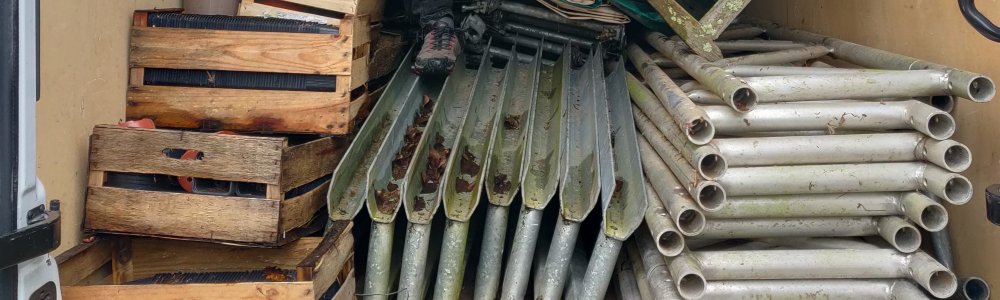
Benoît is in his forties, with short hair and a receding hairline. He is energetic and cheerful, with a slightly mischievous look about him. It is at his house that we pick up our umbrella – or rather, our scaffolding umbrella, which will protect around 120m² of surface area from the elements. It wasn't cheap, but we jumped at the chance when we found it on Le Bon Coin: rain will be our main enemy when we put up the walls this summer. Benoît explains how the contraption works, and we discover that we're going to have to find scaffolding with tubes spaced 1 metre apart to set it up on our site, which is ‘very rare’. So be it. We're no strangers to a challenge...
And we don't have too much of this 16-cubic-metre lorry to load the parts that make it up. Two tonnes of metal in a two-tonne metal belly. Fortunately, Benoît lends us a hand. The conversation flows freely. We talk about Chinese martial arts – he practises Wing Chun kung fu. ‘Are you going to build your house yourselves? You're going to have so much trouble! I have such admiration for people like you!’ As the heavy ladders disappear into the boot, he opens up. Benoît is selling all his roofing equipment because he no longer wants to be the boss of a company. He wants to give meaning to his life. He asks us if we know any of the major Buddhist centres in the area. He met the monk and photographer Matthieu Ricard, ‘a profound man, who doesn't tell you what you want to hear.’ Clearly, it was an encounter that left a mark on him. He talks about his hesitation to send his son to school. He is considering selling his house and travelling around the world with his family. ‘The hardest thing is finding the balance between personal quest and family life. And I feel quite alone with these questions.’
Another conversation that we don't have time to fully engage in... At least we had time to switch from formal to informal address. Reluctantly, we shake hands and say goodbye.
3. Newt
3 p.m. Back in Bergerac seven hours later. We're way behind schedule – thanks to Nils, who turned our route into an obstacle course, complete with tree trunks and power lines fallen across the road. After a quick bite to eat, we move on to the second phase of loading the lorry. Lighter things this time, at least physically, but not without weight: Dad's good bike, which he hasn't used in perhaps twenty years. The bench from the terrace at L'Aiglière, covered with splendid patterns of multicoloured lichens. And above all, wooden crates filled with hundreds of plastic pots for Mayuan's future tree nursery – brought back by Llo and Amandine from a painful auction: that of a market gardener who had to liquidate his business, overwhelmed by debt.
In one of these desintegrating crates, suddenly, a slow movement. Pale green limbs, speckled with black. A lizard? Never seen a lizard in winter... and this one has a beautiful orange line running down its back, from head to tail. We place it in a new hiding place where we hope it can continue to hibernate in peace. We later learned that it was a marbled newt. A species classified as ‘vulnerable.’ Sleep well, little newt, and take care of yourself.
4. David
5 p.m. As we approach this small village in Gironde, the forests of Périgord gradually give way to vineyards, which soon cover the whole landscape. Wine-growing region: Saint-Émilion.
David refused to give us his telephone number on Le Bon Coin. ‘I'm having trouble speaking at the moment, you'll understand when you see me.’ Indeed: he has a plastic valve implanted in his throat, which he has to press to be able to speak. Cancer. He lives in a tiny, windowless flat overlooking a noisy street. With his help, and that of an elderly lady – his mother? – we load up our third and final load: new benches for the Countess of Shortbuttocks, a chainsaw, and a hedge trimmer that should come in handy for trimming our straw bales. We also take a stainless steel sink and two sturdy caravan shelves, which will surely be useful. The boot is starting to get pretty full, but it'll do. As soon as the game of Tetris is over, the old lady eagerly lights a cigarette, looking delighted.
David is thrilled to learn that we live in Pau, and even more so that we're in the Ousse-des-bois neighbourhood. He himself spent 25 years in Béarn, working as a removal man, and used to go to the Hameau market on Sunday mornings. He misses the mountains. ‘The landscape here is really nothing to write home about.’ Stupidly, I say that at least this is a land of good wines, around Saint-Émilion. They scoff. ‘Yeah! Except we can't afford them.’ And I think back to this map of France showing the [most polluted areas](https://lareleveetlapeste.fr/ la-carte-adonis-revele-les-regions-les-plus-exposees-aux-pesticides-en-france/) by pesticides: this region is one of the most affected in the whole country (just like the corner of the Gard where I grew up, for that matter). And I wonder if David's cancer could have something to do with these surrounding wine-growing areas, whose produce is so out of reach?
We say goodbye to them and leave.
5. Garonne
6:30 p.m. La Réole. ‘Exceptional flooding’ according to the official description. According to online maps, we should be able to cross the river, but doubts remain – this is one of the areas that has been hardest hit in recent days. Many streets leading to the city centre are blocked.
The D9 bridge is open. In the golden light of the end of the day, we pass over a vast expanse of water. Here and there, a house emerges from the flood. A great liquid dragon has swallowed everything – the Garonne. As we cross the bridge, these facetious Columbians called Meridian Brothers take their cue to hum in our truck: ‘¡No es tan malo, no es tan malo, todo está mejorando!’ (It isn’t all that bad, and it's all getting better).
Spewing out our CO2, we head towards Pau through the pine tree monocultures of the Landes region. Night envelops us on the straight road. In the end, it didn't rain all that much. We didn't even need an umbrella!
Notes
1. On February 12, neofascist activist Quentin Deranque was beaten to death by antifascists in the streets of Lyon, which led to a nationwide uproar. It was later revealed that Deranque was part of a gang that actually ambushed the antifascists, who defended themselves in a rather extreme fashion. This event took place in a highly charged context of municipal elections in France, in which the extreme right will most likely emerge strengthened. Europe 1 is a radio station owned by far-right billionnaire Vincent Bolloré, who has turned it into one of its key mouthpieces for his ideas. ❁